sábado, 15 de mayo de 2010

23º Aniversario Ley Nº3.258, Resistencia Indígena, Campesina y Popular

La Leonesa, 14 de mayo de 2010.

Con motivo de celebrarse el 23º Aniversario de nuestra Ley Nº 3.258, se reúnen los Pueblos Qom, Wichí y Moqoit en la comunidad “Maipú”, cercana a la localidad de La Leonesa. El Encuentro esta encabezado por el Diputado Egidio García y su Equipo Técnico.
Multitudinaria presencia indígena estuvo en el acto que dio inicio a la jornada, numerosas delegaciones de la provincia pertenecientes a los tres pueblos de nuestra provincia que contó además con hermanos de otras localidades de Formosa, Rosario, entre otros.

También estuvieron funcionarios de la Municipalidad de La Leonesa y la Diputada “Lela”, Presidentes de Asociaciones y Organizaciones comunitarias, pastores y miembros de las distintas iglesias.

Como parte de los actos se hizo presente el coro toba Chelalapi, que brindaron sus canciones con el entusiasmo del público presente.
El encuentro de los Pueblos Aborígenes del Chaco, en asamblea presentarán y analizarán distintos temas ó cuestiones como lo expresan los dirigentes.
El Encuentro se priorizan temas que se tratan de cuestiones relacionados a Salud, Educación Cultura, legalidades y temas jurídicos, Producción y agricultura, entre otros. Los temas de prioridad son tratados en Comisiones, con un Coordinador, moderador y un Secretario que tomaran notas de todas las expresiones de los presentes. Luego, estas producciones se presentarán en Plenario para su debate entre todos.
Durante la primera jornada se deja expresa constancia del tratamiento de la Ley Nº 3.258, para su actualización mediante propuestas de ampliación, modificatoria de algunos de sus artículos y capítulos.

Las jornadas se extenderán desde el 14, 15 y culminará el domingo 16 donde se confeccionará una declaración conjunta y un documento final.

jueves, 13 de mayo de 2010

Asamblea de los Pueblos Wichí, Qom y Moqoit

Misión Nueva Pompeya, 13 de mayo de 2010.

Asamblea de los Pueblos Wichí, Qom y Moqoit

Los día 13 y 14 de mayo del presente año realizará la Asmablea de los Pueblos Wichí, Toba y Mocoví, en la comunidade del Paraje "El Araujo"-Kastak Lhiley" a los fines de elaborar un documento general en el marco del Bicentenario (1810-2010) donde se establecerán las reales situaciones y alternativas para desarrollo social y comunitario de los Pueblos Originarios de la provincia. Los temas refieren a salud, educación, vivienda, medio ambiente y naturaleza y recursos naturales entre otros.

viernes, 7 de mayo de 2010

Hunhatilh toj Hip’akwek (Naciones Unidas) Lakalelhthayaj toj yomeshe Wichi Lhayis lan’oyajhay

1

Resolución aprobada por la Asamblea General

61/295. Hunhatilh toj Hip’akwek Lakalelhthayaj toj yomeshe Wichi Lhayis

lan’oyajhay

Nilhukej Lhaihetwek,

Totchema lhometna toj tolhejlo lhamilh toj tiwaynej che toyenlhi mak toj

tiw’en toj pajche ihi lhip toj wak’alh ½ tolhejlo lhamilh hin’ulh toj lan’oyaj ihi tot’alha

che yenlhi, tohaj 29 de junio de 2006, ihi lhamilh tot’alha che yom is’alhuhu mak

che hope tilesayen toyomey tifwelhtoj ihi tokalelhthayaj toj y’ajpe’ nilhukej hunhatilh

toj yomeshe hop wichi lhayis lan’oyajhay,

Tontichunche mak toj pajche wak’alh toj ihi 61/178, tohaj 20 de diciembre

de 2006 tinufwat toyomchitsajpho toj pajche toyelhta wet tiw’aylhathi toj totchema

toyenkhoya toj tokalelhthayaj yomeshe toj ihi lapes che tiw’aylhateshi toj toyom pitaj

lawhoy yomlak totefwlhache toj toyenkojyajha toj pajche tifwenhu mak toj toyomey

hote tinufwat hop mak to pajche wak’alh toyelhta toj tolhejlo hop tokalelhthayaj toj

kamaj nomahu hop lawhoy toj ninufwa hop seiscientos lhipey toj tiw’enhathen toj

kamaj nomahu lawhoy toj tiwulhipeya hop lawhoy toj tachen toj lhamilh itetshan che

yom wak’alh mak toj yenlhi,

Lhamilh toj ihi Hunhatilh toj Hip’akejwek mak toj yenlhi wak’alh mak toj

yomeshe wichi lhayis toj ipe’ hunhat tip’ajtej lhip toj yenlhi athana.

107° sesión plenaria

13 de septiembre de 2007

Anexo

Hunhatilh toj Hip’akwek (Naciones Unidas) Lakalelhthayaj toj yomeshe Wichi Lhayis

lan’oyajhay

Nilhukej Lhaihetwek,

Tichen yomlak tipoyenamehen hop mak toj tichenkat toj tot’eylok toihanej

mak toj hope toj ihi tolesaynek toj hope Hunhatilh toj Hip’akwek wet mat toj is mak

toj iwuye toj t’eylok timatitche toj tinityenej che totchema hop toniyatyajhay toj

toiheminche toj ihi tolesaynek,

Toyomkalelhoj che wichi lhayis toj w’enhahiche nilhukej hop wichi iyhoj wet

tontofwelej toj kamaj hopet’at lawhoy toj ton’oyaj iyej hotet iwuye nilhukej wichi iyhoj

toj w’enchelhamej wet yup titihi mayek molhyej iwuye lhamilh,

Hunhatilh toj Hip’akwek (Naciones Unidas) Lakalelhthayaj toj yomeshe Wichi Lhayis

lan’oyajhay

2

Hote toyomkalelhoj che nilhukej wichi lhayis tach’uta mak che hope toj

w’enchelhamej, wet y’ikanej toj tach’utlhamehen wet lhoy’a lakeyis, che yenlhi mak

toj lhamilh lakeyis toj lhalwehey,

Lhoy’alhip toj toyomkalelhoj che nilhukej tochefwenyajhay, tolhomtes wet

tohanyhayajay toj tolhejlo lhamilh toj lan’oyajhay ihiche toj tolhejlo wichi lhayis wuk

lhamilh wuk che t’amajhej y’isej lhip toj yikchefwi yikhajyen tolhey lhamilh toj

w’enchelhamej, y’ikanlhameshen, w’enhahiche wuk lakeyis hope toj lhaknenayhoja,

tohanyhayaj toj kamatache, wet imayekfwajt’at laha ihihit’e, mak toj is alhuhu tha

kamatache lham toj lhiwutesa wet mak toj iwuyeyhen isit’e alhuhu,

Toyachajhu toj toyomkalelhoj che tolhaikhajyeneshen hop ton’oyajhay,

lhamilh toj hopehen wichi iwatlok nemhi ihi toj lhaknhenhoyayeshen,

Tonlhek’alejlhi mak toj tiwuyeshe hop wichi lhayis toj iteloytej mak toj

kamatache toj toyomeshe molhyej che hopet’at tojtsu, ihi iyhoj mayhay, toj ihi

hunhat toj lhaihetejwek wet ische n’oyej lhamilh lakahunhat, law’etes, wet mak toj

lhamilh isej niwaynayej che tuk hope lhaikhajyenej, ts’ilak lhamej, lan’oyaj tolhejlo

lachemyaj toj yiheminche che lhamilh lhayenlaweheya mak toj iwatcheylo wet

teskanej,

Tontofwelej mak toj che ische tiwuye lhoy’a mak toj nisa toj hope mak toj

tiwatlok toykelit toj titihi mayek wet tiwutesa wuk tichenkat mak che hope toyelhta

mak toj toykalhi hop ton’oyajhay toj toihemin hope mak toj niwefwa toj tolhejlo hop

wichi lhayis. Wet titolhtey mayek hop lhamilh mak toj iwum toj tolhey mak toj wefw,

hop mak toj niwefwa tha hope mak toj toisej wet totch’utlhamahen, wet mak toj

tolhejlo tokeyis, lhomtes toj hope totichunhayaj wet tolhejlo mak toj toihanej toj hope

totetselh keyis toj hopehen tohesey, nech’e toihanejpa iwuye mak toj tohopehen,

mak toj lhoy’a lhip toj is hope ton’oyajhay toj titiyej tokahunhatilh, tow’etes wet mak

toj to’isej,

Hote tontofwelej mak toj ische toykelit toj tiwatlok hope mak toj titihi mayek

wet tiwutesa wuk tichenkat mak che hope toyelhta mak toj toykalhi toj tolhejlo wichi

lan’oyajhay tinityenej che toyomkalelhoj che niyat imatitche lhomet toj yomey wet

yenchelhi iyhoj lhenhay toj tolhejlo laniyatyaj,

Tontofwelej mak toj is’alhuhu che wichi lhayis ihi toj ihi, yenlhi lachemtes

hopkhilak yikhajyen lachemtes toj tolha hin’ulh toj yenlhi mayek toj to’isej,

totch’utlhamahen wet tokeyis toj isen wet hopkhilak ifwit lapes nilhukej tokeyis toj

tolhaknhenhoyayesen wet tolhakn’aytaycho che to’ihi lhip che hope,

Nech’e kalelhoj toj toihanej toj titetshan mak toj ihi wichi toj iwek toj tolhejlo

mak toj wak’alh toj tokojhejlhi mak toj y’ajpe’ tokahunhatilh, law’etes wet mak toj

to’isej che hope mak toj tot’amajhej wet yikhajyenhen hop lhamilh toj itetshan,

tokeyis wet tochemyajhay toj tolha tokathonhoy wet tikhajyenlhi mak che hope toj

toyenlhi toj timatitche mak toj tiwatlok hope mayhay iyhoj.

Nech’e yikalelhoj toj totch’awhiya nilhukej mak toj n’lhamilh nitofwelej lhoy’a

tokeyis che n’lhamilh lhaychefweneshen toj p’ante mak toj pajchehen wet wichi

Hunhatilh toj Hip’akwek (Naciones Unidas) Lakalelhthayaj toj yomeshe Wichi Lhayis

lan’oyajhay

3

iwatlok itunlhameyhen mak che lhamilh yenhilhila lhoy’a toj lhipajt’isha wet yom

matche wet hote mak toj yikalejcho’ toj lawehey ihi toj ichehen hunhat lhip che

hope,

Nech’e n’olhpe mak toj tiw’en nhuhumche toj hope lachinajt’oj iwatlok

n’lhamilh ichemyenlhi wet lhamilh yen ahopeya tokaha wet sulhtawus iwatlok

nemlhayen laweheya hunhat toj n’lhamilh lakahunhat wet law’etes toj n’hopehen

wichi lhayis toj t’eylo latamsek mak toj n’seshen toj n’lhamilh yenlhi toj

iwuseylon’uhen toj nufwu toj n’yhaneshen che n’heminlo che n’wutshayajhej hop

hunhatilh wet wichi toj ihi nilhukej hunhat,

Tontofwelej toj to’ihi toj tontofwelhameshen molhyej tow’etlheley lan’oyaj wet

hop wichi toj iwek toj tefwlhache toj lhiw’enhumche toj lhayenlaweheya toj t’eya,

lhayenchelhi, lhichefwenhen, wet isyenhen lales timathiche toj lan’oyajhayay ihi

han’ofwaj,

Toyentichunhaya che hop ton’oyajhay yomkalelhoj mak toj ihi tolhomet che

toyomatche, timatitche wet iyhoj hop tolhenhay che to’isej ’alhuhu tolhejlo hop

toniyatyajhay wet hop iwek wichi lhayis toj hope, toj ihi lhip che hope mak che hope

toj tonlhelejlhi, toiheminlo, tolhayenlaweheya wet mak toj hope toj tolha lhamilh toj

tolhey hunhatilh toj wes,

Hote toyentichunhayajha che lhamilh yom matche mak toj iwuye imatitche,

wet lhoy’a iyhoj mak toj yenchelhi wet itetshan mak toj tiwuye, toj hopkhila toj

tach’uta yikhajyen lhamilh toj tach’uta tochemet toj ihi wichi toj iwek toj tolha lhamilh

toj ihi laniyatyajhay,

Yachajhu toj tontofwelej hop tolesaynek toj tolha Hunhatilh toj Hip’akwek hop

toj ihi hunhatilh toj atuseyhen hit’enteshi lhomet hop lan’oyajhay toj hope tochemtes,

tach’utlhamehen wet tokeyis che hope (Pacto Internacional de Derechos

Económicos, Sociales y Culturales)1 wet hop lhamilh toj ihi hunhatilh toj atuseyhen

hit’enteshi lhomet hop lan’oyajhay toj nin’olajche tochemeyenhay wet hinh’ulh toj

itetsan mayek (Pacto Internacional de Derechos Civiles y Políticos) molhyej iwuye

tokalelhthayaj wet hop Programa de Acción de Viena2 yom kalelhoj mak toj lahi toj

tolhejlo nilhukej wichi lan’oyajhay toj iwusey che yomey mak toj yenlhi, hop toj tow’et

lakeiyaj wet toihonlhi toj tolhaykhajyenshen hop tochemyaj toj tiwuye tochemtes,

totch’ulhamahen wet tokeyis che hope,

Toykatej athana hawuhisey che lhajlahaya mak toj ihi tojha toj toyomey hop

athana tokalelhthayaj iwusey che ichemyenlhi yomlak nitkawuyaylo makfwaj hop

wichi toj iwek lan’oyaj toj hope che iwusey toihomit, toj tolhaykhajyenej hop maktoj

toiheminche ton’oyaj toj tolha hunhatilh toj atuseyhen,

Toykalhi hop toj ihi totofwnhayaj toj hope ton’oyajhay toj tolha wichi toj iwek

toj ihi tokalelhthayaj hop athana hop itilhameshen lahemnhayaj wet hich’utyenlhama

1 Tiyahin resolución 2200 A (XXI), anexo.

2 A/CONF.157/24 (Part I), cap. III.

Hunhatilh toj Hip’akwek (Naciones Unidas) Lakalelhthayaj toj yomeshe Wichi Lhayis

lan’oyajhay

4

iyhoj toj tolha lhamilh laniyatyajhay wet wichi iwek lhamilh, toj t’eneshi mak toj

tiwutesa toj hope mak toj tolhejlo hop hin’ulh lan’oyajhay nemhi hope che

toknhenhoyalhameshen wet toch’’ayaj toj is,

Toykonitwetho lhamilh toj ihi laniyatyajhay che t’amajhej ithiimayek wet yom

is’alhuhu toj imatitche mak toj iwuyeshe hop wichi iwek toj hopkhila mak toj

tinityenej lhamilh hop tochemetchalh toj tolha hunhatilh toj atuseyhey,

lhayenlaweheya hop mak toj tolha hin’ulh lan’oyajhay wet tifwelh wet

tich’utyenlhamahen hop wichi toj toihemnhen,

Nech’e nolhpe hop lhamilh toj hope wichi lhayis toj hip’akwek iwaynej chek

tefwlhache mak toj laha ihi wet hote wichi lhayis lan’oyajhay,

Towatlok yihanej toj lhamilh yenlhi wet itetshan toj tiw’enhu wichi lhayis tsi

mak toj tamenej pajche toj lhamilh hiw’en tolhenhaytoj tolhumche hunhat toj

wenchelhamej, wet hote mak toj tolhejlo ton’oyaj toj tolhey hin’ulh lhayis iwatlok

iwusilota wet tach’uta hop wichi lhayis toj iwatlo mayek. Wet yom mat toj n’ol mak

toj tolhey Hunhatilh toj Hip’akwek toj lhamilh yenlhi lhenek toj mat toj laha ihi. Wet

lhamilht’at toj yikchefwi wet ichet teshu ifwenhumche nilhukej hunhatilh, hop mak toj

iwaynej ton’oyaj toj tolhu wichi lhayis. Iwatlok toyen imayecha mak toj ihi

tokalelhthayajha toj pajche wak’al wet tatshepiyecha hop mak toj nipajache toj

wak’alh, hop mak toj mat toj laha ihi toj lhamilh hiw’en namhumche ifwalas toj

n’lhamilhas natachehen toj lhamilh yeneshey n’lhamilh laletnhawet toj hope

n’lhamilh lan’oyaj toj nech’e iwusey che wichi lhayis. Lhamilh che yenlhi nilhukej

makche lhamilh toj yenlhi toj tolhejlo hop Hunhatilh toj Hip’akwek toj lhamilh t’eylok

imolhetwek nilhukej mak toj ihi lhip che hope,

Yachajhu toj tontofwelej wet yachajhu toj tikhajyen che wichi lhayis lan’oyaj ihi

nemhi tiw’enhathen nilhukej hin’ulh lan’oyajhay toj tontofwelej toj ihi hunhatilh toj

hip’akwek lan’oyaj, wet che lhamilh hop wichi toj iwek itilhamej lan’oyajhay che

tetcheyhen toj hope mak toj tok niwahina hopkhilak hope mak toj nittoya, hope mak

toj to’isej wet hope tolhenek toj tinufwthu molhyej iwuye hop wichi,

Titetshan hop mak toj iyeshen hop wichi lhayis wefwpe’ hop hunhatilh iyoj toj

wues lhoy’a toj niwesa, wet iwatlok hote toihanej mak toj tamenej hop toj hunhat che

hope w’enhalhamej hop lachemyaj lhoy’a hop lakeyis,

Tot’onejlhi ts’ilak hop tokalelhthayaj toj tolhejlo Hunhatilh toj Hip’akwek toj

yomeshe hop ton’oyajhay toj tolhe hop wichi toj iwek, totefwlhache lhomet toj pajche

ihi molhyej totichunhayaj che matche toj toihonlhi toj ihi totichunhayaj toj

to’islhameshen wet hope toj yopnhumpej:

Artículo 1

Hop wichi lhayis lan’oyaj ihi che nitokw wuk molhyej lhamilh, lhainkontejlhi

nilhukej lan’oyaj toj iyej lhamilh wet matche toj tontofwelej hop toj isej ton’oyaj toj

inameshen.

Hunhatilh toj Hip’akwek (Naciones Unidas) Lakalelhthayaj toj yomeshe Wichi Lhayis

lan’oyajhay

5

Artículo 2

Hop wichi lhayis lhoy’a elh weihalhapej iwusey chik lham toj lhitetshan, hote

wichi lhayis, hawuhisey chik toyen wet imayecha hop lan’oyaj toj iyeshen lhamilh toj

hope wichi.

Artículo 3

Hop nilhukej wichi lhayis hiw’en lan’oyaj che lhamilh, lanechetayaj che

iwuyeyhen wuk yenlhi latichunhayajhay toj tolhejlo mak che lhamilh iseshen lhoy’a

mayhay toj w’enhahiche wet hote wuyey tokeyis toj pajche tiw’enhen.

Artículo 4

Hop wichi lhayis lapes ihichet’e toj lhaikhajyenej lan’oyaj, lan’oyaj ihiche

lhayenlaweheya wuk lhayenniyateyayej makche hope toj ihi law’et wuk ihi lhip che

hope molhyejtsu hop toj isej mak yihanej yomlak yihomet mak toj ihi lhamilh

lachemet.

Artículo 5

Hop nilhukej wichi lhayis hiw’en lan’oyaj che nitoyhata lhamilh lakeyis toj

pajche hiw’en toj hope totichunhayaj toj laha ihi wet hotewuyey n’lhamilh lakeyis toj

pajche tiw’enhen toj molhyejtsu n’lhamilh iwatlok yihaneshen mak toj ahotoy

yenchemtesa.

Artículo 6

Nufwu wichi weyhalha lan’oyaj ihi che ihi hunhat lhip che hope.

Artículo 7

Nilhukej hin’ulh lhayis wet wichi lhayis hiw’en lan’oyaj che lhamilh hin’oltej

hop iyhoj toj kamaj nintofwlayej mak toj pajche yenchemtesa.

Artículo 8

1. Hop wichi lhayis lan’oyaj ihi wet ische newache iyhoj chik fwitaj

ilehatche hop lakeyis.

Hunhatilh toj Hip’akwek (Naciones Unidas) Lakalelhthayaj toj yomeshe Wichi Lhayis

lan’oyajhay

6

2. Hop Niyatyajhay isyenla’alhuhu mak toj kalwetayej chik tiwuyeshey hop

wichi:

a) Hop mak toj tamenej tot’eylok tokniwaynhayej hop wichi toj

lhaykalelhot toj hope wichi lhoy’a hop lakeyis toj laha ihi;

b) Mak toj tamenej hop toj tot’eylok namlawehey hop hunhat toj to’iche;

c) Nufwu mak toj tamenej toj tot’eylok titeypej hop hunhat toj ihi, hop toj

tot’eylok toykonchi hop lhamilh lan’oyaj;

d) Nufwu mak toj tot’eylok tiwuyeshey hop wichi hop mak toj lhamilh

nhuyanaylo’;

e) Nufwu mak toj lhamilh yenlhometa toj fwitaj wichi hope iyhoj toj

w’enhalhamej hope toj itayhatlo hop wichi.

Artículo 9

Hop wichi lhayis wet lhamilh toj wichi iwusey che lhaihethiwek lhip che hope

toj hope wichi toj tolhejlo hop latetselh keyis. Toj lhamilh yiheminche nemhi iwusey

che tofwtaj toknhenhoyan’uyej toj tolhejlo n’n’oyajhay toj ichena.

Artículo 10

Hop wichi lhayis che hope lakahunhat wuk law’etes ihichet’ek titeyla.

Ha’ihichek iwuylasey che tisuyej che kahopeya lhamilh lanech’ethayaj, che newache

mak toj matche toj is’alhuhu toj hope tokanyaj wet iwatlok iwusey che iche mak toj

tiwuhaya.

Artículo 11

1. Hop wichi lhayis hiw’en lan’oyaj wet law’etej chik nileyayej lakeyis, wet

lachemyaj wet lhamilh t’amajhej, wet no’seyej lachemyaj toj pajche, wet hote toj

tatay’alhuhu hop tokeyis, molhyej tow’etes, toyomeypej hop mak toj pajche, molhyej

toj lhamilh iche lawhoy toj lhamilh iwulakojyaja.

2. Wet laniyatyajhay iwahin toj tinechaynhi hopkhilak is wet toyakha

lhamilh hop mak toj top’ante suyej toj hope p’ante hop lakeyis toj lhamilh

yiheminp’ante, hop lakeyis toj lhamilh isej p’ante.

Artículo 12

1. Hop wichi hiw’en lan’oyaj che lhayn’olit, itetshan, yenlhimayek wet

lhichefwenej lachemyaj, lakeyis wet iwuheseya wet lakeyis ische: t’amajhej wet n’oyej

hop law’etes toj tohesey ihi wet tokeyis ihi che lhamilh tapilhchehen lhiwaynhit’e

Hunhatilh toj Hip’akwek (Naciones Unidas) Lakalelhthayaj toj yomeshe Wichi Lhayis

lan’oyajhay

7

ichemyenlhi wet iniwhipe’ mak che hope tokho wet tot’amajhej che toyakkhey

top’istek hop hun’hat toj law’et p’ante.

2. Hop niyatey yelhthiyela che nithayena ton’oyij wuk mak che hope tokhoy

p’ante wet top’iseyhay toj ichepej hop toj isej toj toyenlhi lahi toj kalelhoj, titetshan

toykalhi toj tolhejlo lhamilh toj lhayp’ajtej wichi toj lahesey ihi.

Artículo 13

1. Wet wichi lhayis hiw’en lan’oyaj che lhamilh yoplej toj ichemyenlhi

toch’utyaj toj pajche yikalhiche wet ifwenhumche iyhoj toj nech’ayhis mak toj lhamilh

tatayey lhoy’a ifwalas toj tottachehen, wet hote mak toj ahotoy nhanayej iwatlok

nech’e tiwulheyisa, wet nufwu toj itetshan.

2. Hop niyatey hiw’enla’amhumche wet amilh lhenla akhoya wet amilht’at

tojlateshan che kan’olhtayej amilh han’oyaj wet hote amilh iwusey che lhom matche

toj ahopehen wichi lhayis, hopkhilak nufwu toj n’haneshen wet n’lhifwenhumche

tolhenhay iyhoj toj iche toyomejwetho wet toykalelhotcho’ wet mak toj yikalelhojcho’

toj matchehen wet che fwalatoj hope n’watlo che ichetitnhuyeshen wet n’temchehen

toj lhamilh yenlhi toj lhenhay che n’yheminchehen.

Artículo 14

1. Hop wichi lhayis lan’oyaj ihi wet itetshan mak toj to’ihi, molhyej

tochefwenyajwus toj iwatlok yenchefwenyaja lhamilh lhomtes, wet tefwlhache hop

lakeyis wet lahanyaj.

2. Hop wichi weihalha molhyej no’tshas, hote lan’oyaj ihi wet

haw’enhilhamej hop lachefwenyaj toj ihi lhamilh is chek toknena wet imayecha.

3. Hop laniyatyajhay itetnhila mak toj is’alhuhu lhoy’a wichi lhayis,

molhyej toj weihalha wichi lhoy’a no’tshas, hote molhyej toj neyahi iyhoj, hote iwusey

chik yikalhi hop lahanyaj toj lhamilh lakeyis lhoy’a lhomtes.

Artículo 15

1. Wichi lan’oyaj ihi mak toj law’etej wet w’enhahiche hop lakeyis,

yomepej latetselh lhomtes wet latichunhayaj hope mak toj matchen’olpe’ toj ihi to

chefwenyaj toj ihi wichi wet isej toj tifwelh toj wichi tatache.

2. Hop niyatey yenla hopeya mak toj w’awelhcho’ toj toykalhi. Che tifwelh

wet tonfweshu tolhithatlo wichi toj lahesey ihi yomlak tottaylo’ mak toj tiskat wet

titoyhatche toj toknhenhoyan’uyej wet tolhikhajyenhen titeloytej. Tohanyhayaj toj isen

toj tolhejlo hop wichi toj yihanhunhatej wet nilhukej lhamilh toj lakeyis

w’enchelhamej.

Artículo 16

1. Hop wichi lhayis hiw’en lan’oyaj che yenlhi mak che lhamilh toj

lhifwenhumche wet yihona lhomtes iwatlok kani n’ofwelachehen. Iwatlok yihuyahen

nilhukej tolhometwus toj ifwelwetho totichunhayajhay toj kahopeya wichi wet iwathi

t’eylok lhiwenhatlhi wuk hiw’enhatlhi’am.

Hunhatilh toj Hip’akwek (Naciones Unidas) Lakalelhthayaj toj yomeshe Wichi Lhayis

lan’oyajhay

8

2. Hop niyatey hiw’enla’amhumche wet amilh lhenla akoya wet amilht’at

toj latetshan lhom matche toj is hopkhilak lhamilh toj ifwenhumche iyhoj toj

yenchemtesa toj lhamilh w’enhayej wet inufwthu tokeyis toj n’hopehen wichi. Hop

niyatey iwathit’eylok yikoncho n’lhamilh che lhamilh toj lanech’ethayaj, hopkhilak

matche toj iwahinnamej che n’lhamilh nufweshu toj yenlhi iwatlok yikonyenwetho toj

lhometwus ifwenhumche iyhoj toj lawekw ihi wet ifwenhumche toj mat toj n’keyis ihi

toj n’hope wichi.

Artículo 17

1. Hop wichi lhayis yihanej mak toj lham iwuye, molhyej lan’oyaj, iwusey

chik ihi hunhat lhip che hope.

2. hop laniyatyajay law’etej chik tay’otshan wet hiwaynheyej mak chik

hope toj iyej no’tshas. Tokniwaynhayej chik tichefwenej mak toj ni’isa hop no’tshas,

tontichuna lhamilh toj kamaj lachemyaj hope no’tshas toj laha ihi hop lahanyaj

pajche iyeshen lhamilh lhoy’a lan’oyaj.

3. Hop wichi weihalha lan’oyaj ihi is chek toyenhopeya iyhoj toj

tot’amajhej, molhyej toj ihi lachemet.

Artículo 18

Hop wichi lhayis hiw’en lan’oyaj che ts’ilaklhamej che ithatwek lanech’ethayaj

che iyahinpe’ mak toj titiyej lhamilh wet hote lan’oyaj toj is’alhuhu toj lakanyatey

yenkeyisa toj lhamilh nufwu toj yiheminche mak che nufwu toj isisha toj ihi law’etes

wet hote lhamilh iwathit’eylok ileyeshen toj iwuyeshen mak toj pajche lakeyis wet

lhamilh iwatlok w’enhejchehen wit yom matche toj nufweshu.

Artículo 19

Hop laniyatyaj toj lhayenlaweheya nilhukej mayhay, iwatlok iwosilota

n’lhamilh che t’eylok yom matche toj itiyej wichi lhayis lach’utyaj wet ichefweneshen

mak toj hope lhamilh lakeyis, nilhukej lhamilh ihi thatlawek che hiwaylhatcho

lan’oyaj che itiyej n’lhamilh toj ichehen hunhat lhip che hope che iche mak toj kani

isa to’ihi n’lhamilh wet hop lhamilh iwusey itsepyenche wet hote toj iwatlok

lhifwenhumche,

Artículo 20

1. Hop wichi lhayis hiw’en lan’oyaj che nileyayej mak toj pajche

yihaneshen wet iwusey che yenlhi mak toj hope lan’oyaj wet nufwesho hote iyhoj toj

w’enchelhamej lhomtes che lhamilh t’eylok is mak toj iwoyey iwatlok itetshan

iyhojfwas to’ichehen lhipey yomthilak yihanejpa wuyey n’lhamilh lakeyis toj yenlhi

mak toj isyen wichi lhayis wet mak che n’lhamilh iwoyey iwatlok n’hesey iyeshen

n’kathonhoy lakeyis toj is’alhuhu toj yenlhi mak toj matche wet isyen nilhukej

n’lhamilh.

2. Lhoy’a mat toj n’lhamilh lhenhay wet n’lhamilh hiw’en lan’oyaj che

ineyhatpho yom matche wet hiwalhathi laha toj n’fweshu.

Hunhatilh toj Hip’akwek (Naciones Unidas) Lakalelhthayaj toj yomeshe Wichi Lhayis

lan’oyajhay

9

Artículo 21

1. Lan’oyaj ihi wichi ihichet’ek nhenhoyayej elh, toj lhayenejlhi mak toj

hi’isyen hop lhamelh wet mak toj isej, che yachajho taj lhayp’ajtiwek toj ihi

tochefwenyaj, tochemyaj, tichefwenej mak che hope wet yachajho toj hip’akejwek

lahanyhayaj, lawekwey ihi lhat’eyahen, t’elhama wet kalelhoj toj tach’utlhamahen.

2. Hop niyatey yihanej iwuynesha che yom w’awelhcho’ mak toj yikalhi wet

yom is’alhuhu toj yenlhi mak che hope yomlak kalelhoj toj hi’isyen’alhuhu mak toj

to’isej wet totch’ulhamahen ichejhonthiyesha mak toj lham toj lawekw tach’awhiyela

lhamilh toj lan’oyaj ihiche. Wet mak toj lhoy’a lhip toj thonhoy iwatlo hop atsinhay,

mamses, no’tshas wet lhamilh wichi toj lawit’oyis ihiche.

Artículo 22

1. Wet lhamilh tach’awhiya wet itetshan lan’oyaj toj tolhe iyhoj toj thonhoy

lhoy’a atsinhay, mamses wet no’tshas, wet wichi weihalha iche iyhoj toj

lajlakajyhayaja.

2. Lhamilh itetnhila lhoy’a wichi lhayis iwatlok tot’amajhej atsinhay wet

no’tshas, wichi yiheminche che iche mak toj tich’utyenesha lhamilh.

Artículo 23

Hop wichi lhayis hiw’en lan’oyaj che its’ilaklhamej che yenlhi mak toj

yenlhel’iya che t’eylok iwuyehen toj lhamilh lakeyis wet lhichefweneshen toj lhamilh

lan’oyaj che yenlhi mak che hope wet n’lhamilh toj mat toj n’keyis toj n’hopehen

wichi lhayis, n’wen n’n’oyaj toj mat toj nikeyis toj n’yenhil itsepyencho’ che n’yenlhi

nilhukej mak toj tolhejlo n’chesyaj n’w’etes hepey lhoy’a iyhoj toch’utyaj che

n’lhamilh nufwu toj lanech’ethayaj che itshepyencho’ mak che tiw’enhu toj tolhejlo

n’lhamilh lakeyis.

Artículo 24

1. Hop wichi lan’oyaj ihi che kamaj ichemyenlhi lakachalh toj tolhejlo hop

lhamilh toj pajchehen wet t’amajhej lhichefwenej che isej. Hal’oy toj hope tokachalh

toj t’amajhej tshowet t’alho wuk lape wet tokachalh toj kachawus toj itetshan che

to’isej. Lhamilh toj wichi iwusey lan’oyij ihi che yihuya kachaw’et han’w’enhi tuk

ton’ofwtseya wuk toknhenhoyayej toj ihi nilhukej tochemwetes wet kachaw’etes

iwusey che toihuya.

2. Lhamilh toj wichi lan’oyaj ihi che akojhejlhi latesej toj nech’e w’awelhi

hop lhamilh toj iwusey toj takhajhayhey wet yihaneshen imayek. Hop Niyatyajhay

tachemhiyela itetshanhila che hope mak toj tiwatlo yomthilak neklhapho mak toj

tiwatlo toj tolhe wichi n’oyaj.

Artículo 25

Lhamilh toj wichi lan’oyaj ihi che t’amajhej wet lhaykhajyeshen che yihemin

toj lahesey iyej lakahunhat law’etes, lhoy’a inot, inot lhipey wet lhoy’a mak toj to’isej

tolhey tokeyis toj lhamilh lakeyis chemyenlhi lakey che hope toj lhenlhi mayek wet

Hunhatilh toj Hip’akwek (Naciones Unidas) Lakalelhthayaj toj yomeshe Wichi Lhayis

lan’oyajhay

10

lhayenlawekwayej mak toj lamatitche che tinityenej che yenlhi mayek yomlak lhamilh

toj nekche lhan’oyij isej.

Artículo 26

1. Hop wichi lhayis lan’oya ihi molhyej hunhat law’etes hop mak toj wichi

isej toj pajche yenkeyisa wuyche iche lakeyis iyhoj.

2. Hop wichi lhayis lan’oyaj ihi ichemyenlhi wet itetshan law’etes tsi iche

mak toj isej, wet lhamilh matche lakeyis toj iyeshen lhamilh yenkeyisa.

3. Wet laniyatyajhay t’amjhiyesha mak toj t’amajhej lan’oyaj ihi toj ihi

lakahunhat toj lhamilh isej, molhyej lachemyhaj, lakeyis toj pajche yenkeyisa toj ihi

hunhat iwatlok tinit haynej che is’alhuhu.

Artículo 27

Hop laniyatyaj itetnhila lhoy’a hop wichi lhayis wet hote hope iyhoj toj

niwenalhamej iwatlok tiw’enhu hop lhamilh hop lan’oyaj hopkhilak nileyache hop

lachemyaj toj hope wichi lhayis wet tiw’enhu lan’oyaj toj lhamilh hope iyhoj toj

law’etes hunhat. Wet iche mak toj wichi isej toj ihi, wet hope mak toj lhamilh

tachema, wet hote wichi iwusey chik yenlhi mak toj lhamilh yiheminche, tsi isej hop

lan’oyaj.

Artículo 28

1. Hop wichi lhayis lan’oyaj ihiche lhamilh hi’isyen mak che hope toj

kats’iya, hop toj isej che iwusey toy’eythu mak che hope toj toihemin toyachajhe

wichi mak toj pajche lawehey p’ante, che lhamilh iwusey, mak che hope toj

toykonchi iwatlok tiwuhaya toj is’alhuhu w’awelhi, tonwayhit’epe makfwaj wet

tiw’aylhathi laha, hop hunhat toj tamenej, hop tow’etes hop mak toj toyomeyhen

tolhey lhamilh lakeyis itilhameshen toj hope lawehey wuyche icheyenlhi wuyche

yenejlhi mak elh che hope wuyche nilhuka elh toj ton’oyeshu mak che hope iwum

mak toj isej che itemhatlo mak toj laha ihi, totchema, totchemwetho, to’ihi toj

toyomey mak toj matche toj iwusey, toj tachen mak toj imolhhen, nech’e toihanej

che tifwelh.

2. Isej toj lhamilh wichi lhayis toj iwek lhaykhajyeneshen mak che hope

hiw’en toj yomeyhen mak toj nhemnache tejche mak che hope toj tot’eylok toykonchi

tha iche mak che hope toj tot’eylok toykonchi tha iche mak toj t’eneshi hope

tokahunhatilh, tow’etes w’awelhi mak toj to’isej, toyom chitsajche hunhat, wet to’ihi

lhip isilataj toyom kalelhoj toykalelhtej hop niyatey wet tokneyahi toj tot’eylok tisuyej

mak toj laha ihi wuk mak elh toj toyenejlhi mak toj tot’eneshi.

Hunhatilh toj Hip’akwek (Naciones Unidas) Lakalelhthayaj toj yomeshe Wichi Lhayis

lan’oyajhay

11

Artículo 29

1. Lhamilh wichi toj iwek lan’oyaj ihiche t’amajhej wet t’eya mak toj

tolhejlo hop law’et wet ihi toj yihanej che tetcheyhen toj ihi lakahunhatilh wuk

law’etes wet mat toj isej toj tolhu lachemet, hop niyatey yomla yikalelhojcho’ lhamilh

wet yenchelhi lachemtes toj ihi lhamilh wichi toj iwek hopkhilak t’eneshi mak toj

t’amajhej wet t’eya, ha’ihiche toknhenhoyayeshen elh che hope.

2. Hop niyatey tachemhiyela itetnila yenhilhina mak toj iwuye hopkhilak

tonchelhu tolhomet lhamet che toknit’amjhayej che toknit’eyayejkanhi che itsoche

hunhat mak toj tot’ilek toj ihi hunhat wuk tow’etes toj hope wichi toj iwek to’ihi toj

toyomey mak toj matche toj iwusey toj tachen mak toj imolhhen nech’e toihanej che

tifwelh.

3. Hop niyatey hote toj iwatlok hiw’en’amhumche mak toj huwaylhatcho’

lhoy’a toj is’alhuhu tsi t’eylok yom matche toj lhamilh iwatlo toyenelhi tolhenek wet

titetshanlhi lhoy’a toj toikanej tokasthayen mak che isyenhen hop wichi lhayis tsi

nomn’uyahen nilhukej mayhay toj tolhey lhamilh toj yenlhi wet lhitemtej toj

lanech’ethayaj che hiw’enhumche nilhukej wichi.

Artículo 30

1. Toykonchihit’e mak toj hope sulhtawus chemyaj che hope toj pajche ihi

wichi lakahunhat wuk law’etes toykonhit’eylo mak che hope imenyenej wuyche

t’eylok ineya mak toj laha ihi hope che ifwenhu wichi mak toj kalelhoj toj laha ihi wet

tiwuye. Mak toj lhamilh wichi ihi ifwenhumche kalelhoj toj hope tot’alhat.

2. Lhamilh toj Niyatyajhay tay’onhiyesha mak toj is’ahuhu lhayhetejwek

mak toj is’alhuhu lhoy’a wichi toj kalelhojhen, hop mak toj tamenej tineyhatpho mak

toj yenlhi toj lhayenlaweheya wet yenlaweheya lhamilh toj kahoya tochemyenhay toj

lhamilh toj itetshan, toj kamaj toknenalhi tokahunhat wuk tow’etes yomlak n’ol mak

toj sulhtawus itunpho toj yenlhi.

Artículo 31

1. Hop wichi lhayis lan’oyaj ihi wet yikanej itetshan t’amajhej yikalelhot

hop lhamilh lakeyis wet lahanyhayaj lachemyaj pajche toykalelhot mak toj hope

tokeyis tochemyaj tsi pajche toihanej mak toj tot’amajhej molhyej tokeyis toj

to’isejp’ante toj to’ihi p’ante molhyej hal’oy tayhi tohanyhayaj toj hope lhamilh

lahanyaj, nitofwelej tshotoy tokeyis tolhomtes toj pajche toyenlhometa tokuyek lhoy’a

tokeyis toj lhay’ajwek toj hiw’en mak toj iwuye. Wet hote hiw’en lan’oyaj chik

t’amajhej itetshan yikanej wet yikalelhot hop mak toj lawekw ihi, wet tokey toj hope

tokey molhyej tochemyaj tohanyaj tokeyis hop tochemyaj toj pajche toihanej.

2. Lay’ajwek molhyej wichi lhayis wet laniyatjhay itetnhila mak toj ischek

is’alhuhu titetshan wet toykanej mak toj hope ton’oyaj.

Hunhatilh toj Hip’akwek (Naciones Unidas) Lakalelhthayaj toj yomeshe Wichi Lhayis

lan’oyajhay

12

Artículo 32

1. Hop wichi lhayis hiw’en lan’oyaj itetshan toj hope toj pajche tsi wefwpe’

mak toj is toj ihi p’ante hop hunhat hop mak toj tisej p’ante.

2. Hop niyatyajhay iwunlay’otnhayajha wet imathichela lhoy’a wichi lhayis

toj yihemin toj yichej hop lhamilh lachemyajp’ante wet tiw’en toj is chek toihantej

chek tochemet che hope chik ihi hunhat lhoy’a mak toj pajche iche, wet

w’enhilhamej pajche toj tohenetshay.

3. Wet niyatyajhay inech’ayhinla wet hopkhila mak toj is’alhuhu wet

niw’enhalhamej, wet itetnhila mak toj kamaj naknelhoja tsi hope mak toj yikonchi

hop mak toj to’isej toj tolhaiheteshu hop tohesey.

Artículo 33

1. Hop wichi lhayis hiw’en lan’oyej che t’ekwehen che lhamilh yikalelhoj

mak toj pajche lakhoy p’ante lhoy’a mak toj pajche lakeyis toj kamaj itilhamej.

Ischek ton’oyaj toj ische newechek y’ayhatcho n’lhamilh lan’oyaj che n’lhamilh

lhayej ahotoy lhayis toj ichehen hunhat lhip che hope.

2. Hop wichi lhayis hiw’en lan’oyaj che lhamilh iwejyen wet yom matche toj

t’ekwe mak che yenhopeya tokalethayajweta che nilhukej n’lhomilh w’awelcho toj

yiheminche che n’lhamilh t’eylok yopley lakeyis toj pajchehen.

Artículo 34

Hop wichi lhayis hiw’en lan’oyaj che lhaykhajyenhen, yenlhi mayek wet

yikanej mak che lhamilh yenlhi toj lachemet chalh wet lhamilh lakeyis,

lahanyhayajhay, latetselh keyis, yenlhi mak toj is, lhichefwenej mak toj yikalhi wet

chekamaj iche lakeyis wuk hip’ajtitwek mak toj yenlhi toj hope latichunhayaj toj

iwusey che itihi mayek ton’oyaj, tolhejlo mak toj w’awelhcho nichotchewek toj

tolhejlo hop Hunhatilh toj wes toj hope hin’ulh lan’oyaj.

Artículo 35

Hop wichi lhayis lan’oyaj ihi chek itetshan mak toj ihi lhamilh law’etes.

Artículo 36

1. Hop wichi lhayis toj lhiw’enhaten toj ichehen honhat lhip che hope

atufweshey iyhoj. Hote hiw’en lan’oyaj lachemtes kanileyayej che itetshan lhamilh

lakeyis wet hote toj iwusey che yenlhilhamhumche lhomtes toj pajche yihaneshen wet

hote toj iwusey che iwutofwnhaya wet lhich’utyena toj yenlhi mak toj n’lhamilh yenlhi

toj tolhejlo lahanyaj lakeyis, latich’unhayajhay lhoy’a nilhukej mak che iwusey che

Hunhatilh toj Hip’akwek (Naciones Unidas) Lakalelhthayaj toj yomeshe Wichi Lhayis

lan’oyajhay

13

n’lhichefweneshen toj lhamilh lakeyis lhoy’a wichi iyhoj lakeyis toj ihi hunhat lhip che

hope.

2. Wet hunhatwus iwatlok iwusilota wichi lhayis che lhamilh t’eylok itiyej

lach’utyaj wet lhamilh iwatlok t’ekwe mak che kathayache toj hiw’enhu lan’oyaj toj

matche.

Artículo 37

1. Hop wichi lhayis hiw’en lan’oyaj che lhaykalelhthen hopkhilak tihi

mayek timatitche mak che iwuye wet iyhoj yenchelhi mak che hope toj tochemyenhay

lhoy’a hop laniyatey wuk tokaniyatey toj tontofwelej, iyahinpejpe’ wet isej elh mak toj

yenlhi wet t’amajhej niyatej mak toj lachemet wet titihi mayek niyatey toj yikalelhjhen,

timatitche wet lhoy’a iyhoj mak toj yenlhi.

2. Athana ihichet’e makche toknintofwlayej toj ihi tokalelhthayaj toj

yomeshe mak toj laha ihi hopkhit’e che toy’aythu laha wuk titoyhatche hop wichi

lhayis lan’oyaj toj yiwitej hop mak toj pajche kalelhoj timatitche wet ische lhoy’a iyhoj

mak che hope toj toyenlhi.

Artículo 38

Hop niyatyajhay tay’otshan lhoy’a hop wichi lhayis itetnhila mak toj hope

tokho wet lhoy’a lhamilh hote itetshan mak toj pajche yihanej.

Artículo 39

Hop wichi lhayis hiw’en lan’oyaj che yihuya elchehope iwahin lach’utyaj wet

hote toj iwusey che yihuya elchepajche lan’oyaj ihi tsi mak toj tamenej pajche hiw’en

toch’utyaj toj tolhu hunhat elh toj atufwey. Wet yomthilak lhamilh isej n’lhamilh

lan’oyaj toj matche che nilhukej ahotoy lhayis itshepyencho’.

Artículo 40

Hop wichi lhayis hiw’en lan’oyaj che yom isen mayhay toj yenlhi w’awelhcho

toj lhaykhajyenhen wet w’awelhi mak toj yiwitej laha toj toyenlhi tolhejlo hop mak toj

pajche Niyatyajhay iwuheseyape’ wuk tolhey lhip che hope wet yufwajkwet hope

totichunhayaj toj tolhejlo mak toj tiwuheseyape’ molhyej iwuye toj tiwalhat

tinech’aynhi mayek toyom kalelhoj is’alhuhu mak toj iche isit’e che niw’aylhahi laha

che tisuyej lhip toj tolhejlo elh hotefwajpeshi hop lan’oyaj wet yihetwek mak toj

yikalhi. Ihi mak toj yikalelhoj titetshan ische yom matche lachemet toj iwuye, kalelhoj

titetshan hop lakeyis, che hope latetselh keyis p’ante, kalelhoj titetshan wet hop

hip’ajtitwek lan’oyaj toj tolhejlo hop wichi lhayis toj yikalelhjhen wet toyom kalelhoj

che hope mak toj tatshepiche toj tolhey hin’ulh toj ihi Hunhatilh toj wes.

Hunhatilh toj Hip’akwek (Naciones Unidas) Lakalelhthayaj toj yomeshe Wichi Lhayis

lan’oyajhay

14

Artículo 41

Hop lhamilh toj ihi Hunhatilh toj Hip’akwek toj ihi lachemet wet yihaneshen

lachemyajhay lhoy’a hop wichi iyhoj toj hope niyatey hote tach’uta wet yikalelhot,

wet lhamilh yenlhi lhoy’a mak toj hich’utiena yomthilak iwusey mak toj toyenlhi

lhoy’a toj tinech’aynhi wet tot’amajhej hop wichi lhayis.

Artículo 42

Hop nilhukej hunhatilh toj yihuwek lhoy’a iyhoj toj ichehen lhipey wet hote

iyhoj toj w’enejchehen nilhukej mayhay toj tolhejlo wichi lhayis wet lhoy’a nilhukej

ahotoy toj pajche yihaneshen mak toj ihi che wichi w’etes wet hote niyatey toj ihi lhip

che hope wet lhaminla toj inityenej che w’awelhcho toj t’amajche toj nichotejlo toja

toj hope tokalelhthayaj wet lhamilh toj itetshan tokalelhthayaj toj ihi toja.

Artículo 43

Hop ton’oyajhay toj tontofwelej toj ihi tokalelhthayaj athana yenlhi hop

lhomtes toj hope mak toj niwefwa yomlak hope mak toj itetshanpe’ mayhay, hop

mak toj law’etej, wet hopkhilak isyenhen lhamilh toj ipe’ wichi toj iwek toj ipe’

hunhat.

Artículo 44

Nilhukej ton’oyaj lhoy’a toj tohopehen iyhoj toj pajche yikalelhoj toj

tohopehen iyhoj niw’enalhamej.

Artículo 45

Ha’ihiche mak toj pajche wak’al toj ihi tot’amajchet che isuhisha wichi lhayis

lakeyis che lhamilh yenhopeya mak toj is che n’lhamilh hiw’en che fwalak lapesey.

Artículo 46

1. Athana ihichet’e makche toknintofwlayej toj ihi tokalelhthayaj toihanej

ihi toj Niyatyaj, hiw’enhuma mak che hope wichi, tejche nintokwa wuk elh chehope

lan’oyaj ihi che tachema lhip toj tolhu mak toj toykelit toj nech’e toyenlhi che

nimolhyayejtsu wuk toyenlhi mak toj toyomey tottaylo tichene tolesaynek hop

Hunhatilh toj Hip’akwek toj wes wuyche toihantej mak toj tilotche che toyomatche

toj iwahinpho lan’oya wuyche yihetche toj toyenlhi toyenejlhi elh che hope yikchefwi

che tilehatche wuk toy’aythu tisuyej lhip, timolhetwek wuk lhiphaj, tiyojhuma lhamilh

toj ipe’ hunhat wuk lhalwehey toj t’alha Niyatyaj che hope wuk lhamilh toj lan’oyaj

Hunhatilh toj Hip’akwek (Naciones Unidas) Lakalelhthayaj toj yomeshe Wichi Lhayis

lan’oyajhay

15

ihiche toj hopehen lhamilh toj Niyatyajhay mak toj iwuye wet lhamilht’at toj

lhalwehey laniyatyaj.

2. To’ihi toj tolhit’entejche tolhaykhajyenhen toj ton’oyajhay ihiche che

toyomey mak toj kalelhoj toj hope athana tokalelhthayaj, itihila mayek hop wichi

lan’oyajhay wet hope lhamilh nech’e iwusey che yenlhi mayek hop isej nilhukej mak

toj kalelhoj. To’ihi toj tolhit’entejche tolhaykhayenhen tolhejlo toj ton’oyaj ihiche toj

pajche kalelhoj toj to’ihi toj hunhat toj hope athana Tokalelhthayaj itihi toj ihi lham

toj isek ts’ilakhila toj yenhopeya mak toj lajlapesa kalelhoj toj hope mak toj kalelhoj

toj yenejlhi, mak toj matche wet yenejlhi che inityenej hunhatilh che yomkalelhoj

wichi lhayis lan’oyaj. Tojtsu halhpes ihihi hopkhit’ela ton’ofwtseyaj wet hopkhila mak

toj ts’ilak lhamilh toj iwatlok hit’enhatche lhomet toj tolhejlo ton’oyaj hopkhilak

tonchelhu che t’alhesha mak che hope titofwnhathiyesha wet titihila mayek kalelhoj

toj matche hop ton’oyajhay wet iwusey che tiwuye mak toj tolhejlo iyhoj wet

hopkhilak tonfwu toj tokosejwetho wet lhoy’a lhip tow’aytes toj tiwatlo hop tolhey

lhamilh toj lahesey ihi.

3. Toj toyenlhi mak toj toyomeyhen toj ihi athana Tokalelhthayaj lham toj

yikalelhthila lhoy’a toj yenejlhi hop mak toj tachen toj tolhejlo mak toj is’alhuhu toj

tolhey lhamilh toj lahesey ihi hop titihi mayek toj tothejlo wichi lan’oyaj che

tow’awelhi lhamilh, hayip hopkhi ton’ofwtseyaj, hop isilataj mak toj tolhejlo

tochemyaj toj ihi lhamilh wet matche toj toch’’aya.

Wichi del Chaco apoya postulación de Evo Morales Ayma,Presidente de la República de Bolivia, para el Premio Nobel de la Paz 2010

Misión Nueva Pompeya, 7 de mayo de 2010.-


Postulación de Evo Morales Ayma, Presidente de la República de Bolivia, para el Premio Nobel de la Paz 2010
A Señores
The Norwegian Nobel Comité
Henrik Ibsen Gate 51
NO-0255 Oslo
e-mail: gl@nobel.no
NORWAY
Nos dirigimos a ustedes a fin de hacer llegar uestro apoyo a la postulación de Evo Morales Ayma, Presidente de la República de Bolivia, para el Premio Nobel de la Paz 2010.
Consideramos que el Presidente Evo Morales, de origen aymara, proviene de una nación con profundas desigualdades sociales, económicas y raciales, con su trabajo está cambiando la vida de millones de personas, devolviéndoles la dignidad tantas veces arrasada por la violencia, la marginalidad, la pobreza y el racismo.
Su lucha es incansable en la búsqueda de mejorar la educación, el derecho a la salud, a la posesión de sus tierras para la mayoría de la población indígena y campesina de su país, y el respeto a la diversidad cultural.
La trayectoria de Evo Morales trasciende su inserción local, aportando valores universales de defensa y el cuidado de los recursos naturales y el derecho del “buen vivir” de los seres humanos, con respeto a sus identidades.
Su visión integradora conlleva una práctica que busca la armonía de los seres humanos entre sí, y con la naturaleza, en el ejercicio de una genuina interculturalidad enriquecedora.
Asimismo reconocemos su compromiso con la integración latinoamericana, su acción no-violenta en defensa de los derechos humanos en su integridad, y la defensa y preservación de la Madre Tierra.
Es para nosotros un ejemplo de resistencia, de sabiduría y de dignidad para la humanidad toda.
Por su trayectoria y los valores que representa consideramos de fundamental importancia que Evo Morales sea reconocido a través de tan importante galardón.
Con la seguridad de ser escuchados por ese distinguido Comité, los saludamos con nuestra mayor deferencia.

lunes, 3 de mayo de 2010

Celebramos 110 años de Misión Nueva Pompeya - 1900 -4 de mayo-2010

4 de mayo de 2010, un aniversario mas de Misión Nueva Pompeya.

En este Aniversario número 110, el Padre Franciscano Peppo nos dejaba el siguiente mensaje:

"En este día de celebración por los 110 años de la fundación de la Misión Nueva Pompeya. Me uno a la acción de gracias por el camino transitado. Los animo a caminar con pasión el presente y construir con esperanza el futuro para todos en el Pueblo. Abrazos y bendiciones".

Por tanto,  Unidos en la acción de gracias por el camino transitado, caminemos con pasión el presente y construyamos con esperanza un futuro para todos... donde prevalezca la PAZ y el BIEN.


Marco histórico:
Misión Nueva Pompeya fue fundada en el año 1900, fue una obra de los misioneros franciscanos venidos de Salta. La atención especial y preferencial a los wichí de esta parte del Gran Chaco, fue el génesis de esta comunidad.
Ha habido momentos de avances: Pleno desarrollo (1930-1945), significativos avances en cuanto a la tecnología, agricultura y ganadería, la cría de animales de ganado menor y ganado mayor, sistema de educación y alfabetización. Las producciones locales eran llevadas a Salta y otros lugares, para la comercialización y canje de los productos.

Ha habido momentos de retroceso y dificultades: (1945-1950) Gran sequía. Éxodo de familias y comunidades wichí. Ataques y acciones hostiles por parte de los “criollos” en la zona, lo que también, fue una de las causas de abandono del lugar. Saqueos e intentos de invasión. Intentos de expulsión, atentados a los Padres Franciscanos. El fallecimiento de los P. Franciscanos marco una época de indefensión. Una época de muchas acciones hostiles, guerras, enfrentamientos. Acciones militares.

Reorganización: 1970: “La misión” resurge con la presencia, coordinación de la Hna Guillermina H. y su equipo de trabajo. Tomaron en cuenta las iniciativas impulsadas por los Padres Franciscanos. Muchos de los emprendimientos fueron recuperados en base a testimonios orales de los wichí ancianos y ancianas del lugar, algunas documentaciones. Asimismo elementos materiales y herramientas que fueron recuperados y restaurados poniendo su inmediato funcionamiento.

Transformación cultural: organización social, incursión de los wichí en política, gestiones y diálogos con representantes, autoridades provinciales y nacionales.

Industria y comercio: creación de la Cooperativa de Trabajo e Industrialización “Nueva Pompeya Ltda”. Los primeros años “la misión” ha recuperado su esplendor.

1980: Se puede destacar la presencia de Hnos Maristas, congregación que esta presente hasta nuestros días, que en coordinación con ENDEPA y organizaciones comunitarias aborígenes realizan acciones de desarrollo social y promoción humana.

1992: Recuperación y titulación de las tierras, construcción de viviendas, acompañamientos y asesoramiento permanente, evangelización, etc.

1994: Reconocimiento de los derechos de los pueblos originarios (educación, salud, vivienda, etc.) en las legislaciones provinciales, nacionales y convenios internacionales. Reforma de la Constitución.

Destacan el enriquecimiento cultural, la complementariedad y riqueza razón de ello es que en el año del centenario (2000) se denominó “Lugar de Encuentro”, para algunos “Corazón del Impenetrable”.

La comunidad wichí tiene una propiedad comunitaria, dentro de la cual se realizan todos los emprendimientos caracterizados por la acción evangelizadora, la fe, la doctrina cristiana.
Actualmente, Misión Nueva Pompeya, es un lugar con sus matices que lo convierte prácticamente en un ámbito multicultural y multilingüe y, año a año se profundizan.

sábado, 17 de abril de 2010

A propósito del 19 de abril -día del indio americano

Misión Nueva Pompeya, 16 de abril de 2010.

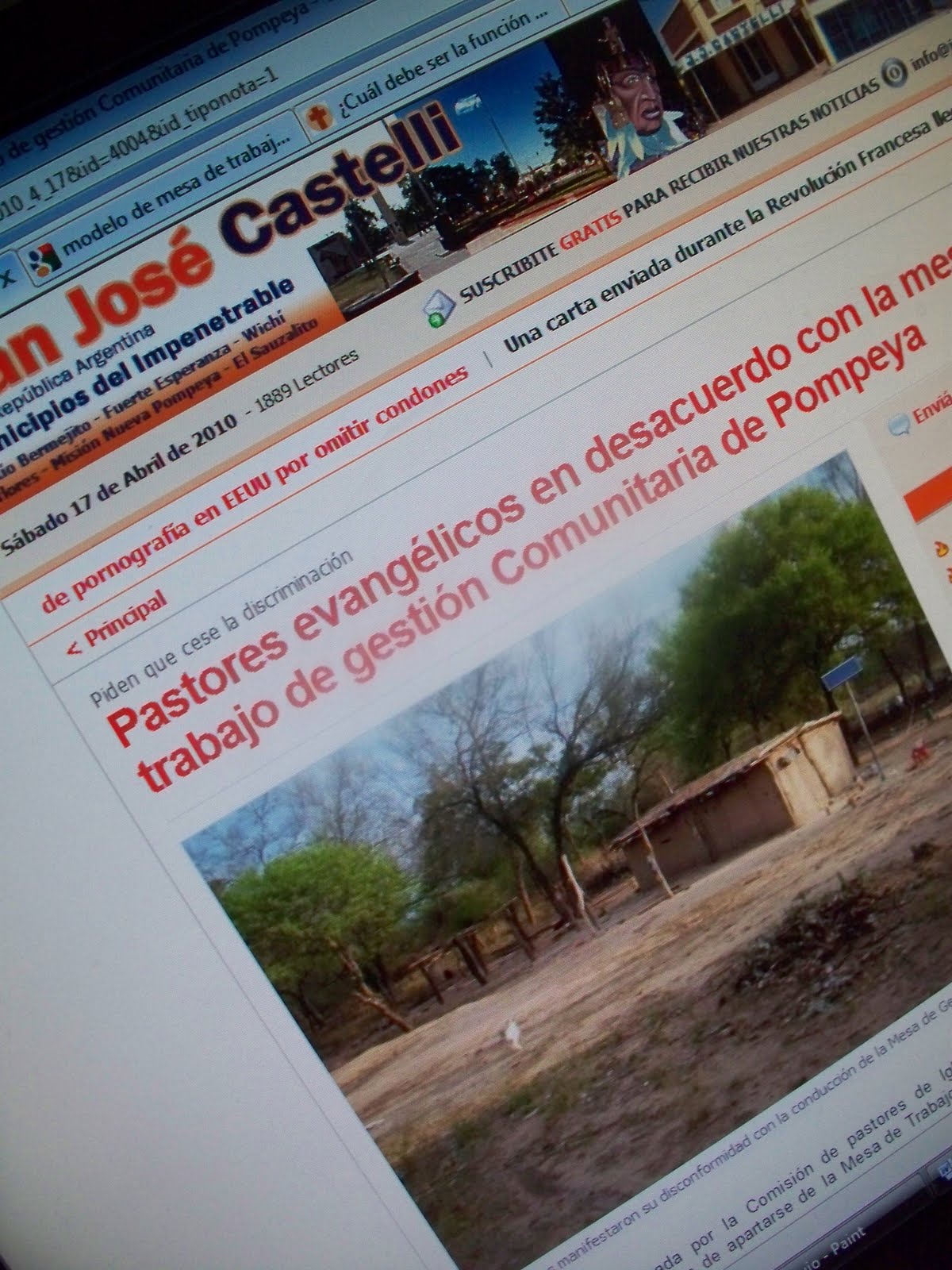
El periódico jjcastelli.com con el título de "Pastores evangélicos en desacuerdo con la mesa de trabajo de gestión Comunitaria de Pompeya". Creemos que se refiere a nuestra Mesa de Trabajo y Gestión comunitaria Wichí" y a una supuesta discriminación. Es un grupo minoritario que tienen contratos municipales y responden al Intendente Vicentes González, que responden a la Alianza Frente de Todos-UCR, quienes piden que cesen la supuesta discriminación. Recordemos, un ejemplo para describir manejos que caracteriza a este personaje. Vicente González y sus seguidores supuestos pastores, reciben donaciones de Córdoba, llevan a las casas de sus punteros políticos y llama la atención que por lo general llevan de noche, nunca de día, y es que allí es donde ocurre la verdadera discriminación. Los supuestos pastores, como LG, MN, MS, renunciaron a la Comisión y dejaron de pertenecer a la Organización Wichí por pedido del Sr Vicentes González y nadie, ningun wichí cuestiona eso. Han sido respetados sus decisiones que fueron de manera libre y voluntaria. Lo que si crea sorpresa e indignación es que hayan llegado a prestarse a manipulaciones que sin dudas no comprenden el trasfondo político que tiene estas acciones de intento de desprestigio, calumnias e injurias, y la oposición a una iniciativa que surge de un consenso y en una época difícil, de dolor, angustia, hambre, desnutrición, de perdida de vidas, muchos hermanos nuestros perdieron a sus seres queridos por males curables y evitables,  y precisamente de la mano de este signo político. Por lo tanto ¿qué podemos esperar de sector político que hizo sufrir al pueblo wichí?

La nota dice lo siguiente: “En una nota firmada por la Comisión de pastores de Iglesias Evangélicas se manifiesto la intención de apartarse de la Mesa de Trabajo y Gestión Comunitaria wichi de Misión Nueva Pompeya debido a desacuerdos con la conducción de esta entidad en el manejo de repartos que realizan entre las familias aborígenes. En el escrito consideraron que se discrimina a las familias a la hora de entregar las mercaderías y otros elementos que el Gobierno envía para la comunidad aborigen Wichi.
Asimismo recordaron que la Comisión Pastoral fue formada para trabajar con distintos partidos políticos, Iglesias, entidades locales y Municipio local sin discriminación destacando que se esta en constante apoyo a las Iglesias en actividades.

“No es motivo para polemizar” manifiestan en la misiva- pero queremos hacer conocer que no todos estamos de acuerdo con esta forma de trabajar de esta Mesa de Trabajo” pero aseguran “de igual forma seguiremos trabajando para conseguir ayuda para nuestra gente que tanto necesita”.

Al finalizar expresaron su deseo “solo queremos que cuando venga algo para la comunidad wichi se reparta a todos por igual y no se haga política o discriminación dejando a los mas pobres afuera”

En mi carácter de Coordinador del Movimiento Wichí, Por la Dignidad, Justicia y Paz, atento a la nota publicada en JJcastelli.com, con el título “Pastores evangélicos en desacuerdo con la mesa de trabajo de gestión Comunitaria de Pompeya”.
En primera instancia, es aceptable que personas, sobre todo wichí, manifiesten sus desacuerdos ante ciertas situaciones, que expongan sus puntos de vista ante situaciones de las que no están de acuerdo y consideran que no son las deseables, que hagan notar situaciones ó acciones que pueden vulnerar sus derechos, pero si nada más que por sí mismas se expresaran, y no bajo presiones, y/o en respuestas a demandas ajenas y favoreciendo a intereses mezquinos y políticos. Criticar sin proponer ni aportar. Además no es bueno arrogarse a la representatividad de sectores para obtener beneficios personales, eso no es bien visto por la mayoría de las comunidades.
En segunda instancia, la situación de las comunidades wichí de los distintos parajes y comunidades no es buena. Existe una situación de pobreza, marginación, y malestar sobre todo económico, social y ambiental. Pero, hoy la situación en todas las comunidades, al menos aquí en la zona de Misión Nueva Pompeya, se puede decir sin miedo que ha mejorado en muchos aspectos.
Hace unos años atrás (han pasado muchos Gobiernos, y esto lo digo con mucha reserva), cuando un wichí necesitaba un poco de yerba, sal, ó, lo que fuere, recurría al vecino, y muchas veces el vecino tampoco tenía, entonces sufren todos, por que todos no tenían nada. Hoy, se puede decir y con todas las letras que hay mejoría. Por que hoy, cuando un wichí necesita algo, lo que fuere recurre al vecino y el vecino sí tiene, algunos tienen y comparten, es parte de un trato y contrato social, por que entre los wichí nos ayudamos, hay reglas claras de convivencia. Se puede decir con total seguridad que hay mejoras como recursos en las comunidades.
No es casualidad que hoy familias wichí mejoran, hay consumo, el mercado local recupera actividad, y así muchas cosas más. Es consecuencia de una lucha, de estar juntos y unidos, una manera de gestión que no es la mejor, ni la peor, es buena por que beneficia, en el futuro habrá alternativas más efectivas, pero por hoy y ante la urgencia, es parte de un proceso de construcción de un modelo de autogestión. Este modelo significa mirar hacia adentro, descubrir y hacer uso de las potencialidades y capacidades dentro de las mismas comunidades, propiciar su visibilización, por que hay una nueva generación con muchas capacidades que tienen la posibilidades de acceder y entrar al escenario político wichí, social y comunitario.
Hoy se presentan oportunidades y se recurren a recursos y formas de organización, en donde surgen nuevos actores sociales, nuevas ideologías, nuevas propuestas, nuevas formas y metodologías de gestión sin dudas actuales, que avanzan sin demasiados protocolos recuperando la identidad étnica y cultural de un pueblo que se debilitaba cargando el pesado yugo de la indiferencia, genocidio, etc. Estos nuevos actores sociales, son los que pasan al frente, conocen a la oposición que no les dejan crecer. Son nuevos actores sociales y protagonistas actuales que no traicionan, son fieles al mandato wichí.
Pero también están los que no quieren sumarse a este nuevo movimiento social, por aferrarse a intereses más bien personales y se oponen, se conforman con el reconocimiento de sus patrones de estancia, con “palmadas al hombro”, contratos basura que son una miseria, pero para la situación de necesidad es suficiente y eso lo comprendemos.

Difícil es convencer que la dignidad de un hombre no tiene precio, que no es un mínimo de $250, para pepetrar ataques y calumnias a otros wichí, que sí trabajan y consiguen muchas cosas para todas las comunidades. Creo que lo único que se pretende es debilitar a una importante organización wichí, que ha hecho demasiadas cosas en las comunidades, y dejar sin efecto logros de toda una comunidad organizada, y no sorprende que algunos quieran también tomar las fuerzas locales que los han desplazado por incompetentes, incapaces, ante el vertiginoso orden mundial (NOM), a muchos funcionarios no les convienen este progreso y promoción humana. Sobradas muestras que la realidad los superan, no quedó demostrada las capacidades de administración ni de gobierno y sin dudas así difícilmente puedan avanzar políticamente, entonces ante estas carencias se recurre a inmoralidades e impudicias.
La inmadurez política conduce que el uso que se le da los recurso ya no es institucional sino de provechos personales, y con todas las características de un autoritarismo puro, sin un plan político, sin un esquema de trabajo, y sí sobran las improvisaciones sin importar el desmedro de los derechos humanos. Importa sí, los títulos, honores en oposición a la lucha por la dignificación de todo un pueblo.

Hay intereses políticos partidarios, que no permiten que los wichí crezcan, por que a ellos no les conviene, pero tampoco tienen capacidad ni esta en mente ayudar. Entonces ¿qué es lo que quieren? No es otra cosa que el deseo de perpetuarse en el poder, en el cargo. Hacen uso de recursos ajenos, cometen actos inhumanos, indecentes, para debilitar a un pueblo unido y en aumento crecimiento. En tanto que los dirigentes wichí queremos que nuestras comunidades vivan bien, terminen de sufrir, porque demasiado hemos sufrido.


Es cierto, hay mejora en los ingresos, pero no se supera la línea de pobreza, seguimos siendo los más pobres entre los pobres. Y ante esta realidad es que hay que trabajar, y mucho. La Mesa de Trabajo y Gestión Comunitaria Wichí, no se dirige a una persona, y no toma decisiones una sola persona. Las acciones se acuerdan entre todos y todos hacemos. Se gestiona para todos, y todos gestionan para todos. Esta iniciativa tiene su origen en el MOVIMIENTO WICHÍ, Por La Dignidad, Justicia y Paz que nació en una época caótica, grave, insostenible y muy dolorosa. Una época manchada con sangre, signada por el sufrimiento, la desperación, hambre, desnutrición, muertes, el abandono y muchas cosas más no deseables y evitables.
¿Por qué este Movimiento? Decimos movimiento por que implica moverse, de no quedarse quieto, no resignarse, por que la situación no está para quedarse tranquilos, hay que levantarse y luchar por los derechos individuales, comunitarios y reclamar aquello que por derecho nos corresponde; es un proceso dinámico que requiere esfuerzos y mucho sacrificio, aun nos falta mucho camino por recorrer y aprender.

En el MOVIMIENTO WICHÍ, Por La Dignidad, Justicia y Paz, decimos “NUFWU NIYATEY”, que afirma que todos somos MOVIMIENTO WICHÍ, Por La Dignidad, Justicia y Paz. Con el claro concepto de que JUNTOS, sumamos, pero UNIDOS podemos mucho más. Hay una misión para cada uno y en este universo nuestro se requiere que todos estemos unidos por una causa, una misma misión que cumplir, todos somos imprescindibles y así entre todos se concretan las aspiraciones, los sueños, anhelos y en cada logro se celebra y se da gracias Dios, es el triunfo de la vida sobre la muerte.
No los culpo a algunos pastores, dudo que haya intencionalidad. No debe existir discriminación política ni religiosa. Hay que ser suficientemente inteligentes para poder discernir el camino a seguir, porque cada acto es una opción de vida, a veces uno elige ser y parecer, el que sabe elige y el que no parece.

El MOVIMIENTO WICHÍ, Por La Dignidad, Justicia y Paz, lucha por la dignidad del más chico al más grande, por la justicia ante tantas injusticias, el trato desigual y buscamos Paz, no hay paz si hay un wichí que sufre. Si todos estamos bien, cada uno y cada una, las familias, las comunidades, vamos a vivir bien y en paz.

Y la reflexión es que cada Pastor y Misionero conozca a Dios, encuentre en El un tesoro más hermoso. No hay otra cosa, no hay persona más importante que Dios.

Nuestro hermano, ejemplo y luchador Sabino Romero decía:
"...uno es tan grande como el enemigo que escoge para luchar y...uno es tan pequeño como grande el miedo que tenga. Elige un enemigo grande y eso te obligará a crecer para poder enfrentarlo. Achica tu miedo porque, si él crece, tú te harás pequeño. Nosotros le tenemos miedo al olvido, al que hemos ido achicando a fuerza de dolor y sangre. Somos, por tanto, grandes".
(Zenón González).

miércoles, 14 de abril de 2010

Nuevamente Empleados Municipales de Misión Nueva Pompeya hacen Paro por tiempo indeterminado

Misión Nueva Pompeya, 14 de abril de 2010.

Nuevamente Empleados Municipales de Misión Nueva Pompeya hacen Paro por tiempo indeterminado.

De acuerdo a las manifestaciones de los empleados Planta Permanente del SUOEM local en reunión han decidido realizar un paro por tiempo indeterminado dado que el Sr Vicentes González, Intendente Municipal, miente todo el tiempo, no cumple con lo que dice, no cumple con los acuerdos pactados hace mes atrás, en donde prometía entre otros temas mejoras salariales, regularizar la deuda de los aguinaldos del 2007, 2008 y 2009, como mejoras en las condiciones laborales y les sigue mintiendo a los empleados al decir que la provincia discrimina, no les manda los fondos y que sufre achique en el presupuesto y rebaja de la coparticipación que reciben mensualmente. Pero tambien se preguntan si no hay fondos cómo hace el Sr intendente para cambiar, ó comprar un vehículo nuevo 0km si la municipalidad no dispone de fondos suficientes?

De lo que se puede acceder el acta dice lo siguiente:
"Acta Nº____En la localidad de Misión Nueva Pompeya, Departamento General Güemes, Provincia del Chaco, a los trece días del mes de abril de dos mil diez, siendo la veintidós se reúnen personal de Planta Permanente de la Municipalidad de Misión Nueva Pompeya, integrantes de la Comisión Directiva del Sindicato Unión de Obreros y Empleados Municipales –SUOEM al solo efecto de tratar los acuerdos establecidos oportunamente con el Sr. Intendente Municipal Don Vicentes González. Dando inicio a la reunión, el Sr. Presidente Don Pedro Ceferino Suárez, da la bienvenida a los presentes y da aviso de los motivos de la convocatoria. Acto seguido los presentes analizan los temas acordados oportunamente con el Sr. Intendente Municipal Don Vicentes González. Luego de deliberaciones e intercambios, los presentes concluyen que hasta el día de la fecha no se han cumplimentado con los temas acordados y las promesas realizadas. Atento a esta situación de incumplimientos, ante la falta de respuestas al reclamo presentado oportunamente ante esta municipalidad, los empleados municipales presentes mocionan realizar un paro por tiempo indeterminado. La moción es aceptada de forma unánime y de común acuerdo se decide la realización de un paro por tiempo indeterminado hasta tanto se dé respuestas a lo solicitado en el mencionado pedido, a partir del día catorce del mes en curso y presente año, autorizando a las autoridades de esta comisión a realizar todas las comunicaciones y actuaciones pertinentes.
No habiendo nada mas para tratar, se finaliza el acto y para constancia firman al pie los presentes. Conste. - - -"

martes, 13 de abril de 2010

Nota de agradecimiento

Misión Nueva Pompeya, 12 de abril de 2010.
Objeto:

Agradecer a Sra. Ministra B. Bogado
Ministerio de Desarrollo Social de la Provincia del Chaco
El Gobernador del Chaco CPN Jorge Milton Capitanich firmó un acuerdo con la Mesa de Trabajo y Gestión Comunitaria Wichí de Misión Nueva Pompeya.
Esperamos y deseamos que entre todos podamos contribuir aquello que "mejor que decir es hacer, y, mejor que prometer es realizar" tenga un signo positivo este año en el impenetrable chaqueño y en particular en las comunidades wichí.
El día 12 de marzo de 2010, como respuesta a las demandas de las comunidades Wichí de la zona de Misión Nueva Pompeya, el Gobierno del chaco, encabezado por el Gobernador CPN Jorge M. Capitanich, mediante la firma de un acta se comprometió a dar respuestas concretas al petitorio presentado oportunamente por representantes de la Mesa de Trabajo y Gestión Comunitaria Wichí del Movimiento Wichí, Por la Dignidad Justicia y Paz.

El Acta Acuerdo refiere a varios temas, entre ellos en lo que refiere a Desarrollo Social y establece:

DESARROLLO SOCIAL

 LA Delegación de Desarrollo Social en la localidad (Sr. Omar Meza) pasará a desarrollar sus funciones en el edificio donde funciona actualmente Zona Sanitaria VII, con oficina propia.

 Entrega de módulos alimentarios de 500 unidades cada 45 días durante 2010, con la primera entrega en marzo (sin afectar Asistencia Alimentaria que en el futuro se implemente en la zona).

 Durante el mes de marzo se realizará un operativo conjunto entre el Ministerio de Desarrollo Social de la provincia y Nación, el ANSES y la Mesa de Trabajo y Gestión Comunitaria Wichí a efectos de identificar beneficiarios de tarjetas alimentaria, pensiones y Asignación Universal por hijo.
 Durante el mes de marzo el Ministerio de Desarrollo Social provincial se compromete a entregar 200 tarjetas alimentarias y regularizar otras pendientes de entrega.
Hay una situación de emergencia social, económica grave que perjudica enormemente a mujeres, niños y ancianos wichí.
Sra. Ministra, ha culminado el mes de marzo y principios de abril, y se ha avanzado en particular los acuerdos establecidos oportunamente como:

 entrega de tarjetas, nuevas y pendientes,

 Entrega 1.300 módulos alimentarios.

Como asimismo el compromiso de avanzar en temas pendientes de manera conjunta.
Consideramos que el trabajo conjunto, coordinado y articulado con la participación wichí es el mejor camino que se construyen respetando y dialogando.
Dejamos expresa constancia de agradecimiento a Ud. y personal a su cargo que posibilitaron y facilitaron este operativo en la zona, atendiendo y participando de variadas acciones.
Desde ya, ofrecemos toda nuestra colaboración.
ATTE. -
Zenón González – COORDINADOR

Desarrollo Social en Misión Nueva Pompeya

Desarrollo Social en Misión Nueva Pompeya, 12 de abril de 2010.

Representantes del Ministerio de Desarrollo social de la provincia, realizaron un operativo conjunto con la Mesa de Trabajo y Gestión comunitaria Wichí, en el marco del Movimiento Wichí, Por la Dignidad, Justicia y Paz, en la localidad de Misión Nueva Pompeya, con la coordinación de Patricia Aleric acompañada por pedro Pablo Pérez “tunino”, Rogelio Vallejos, Miriam Fernández, Oscar Forlín y el Sr Omar Meza.

El operativo conjunto consiste en la entrega de nuevas y pendientes Tarjetas Alimentarias de Social Pass, en las localidades de Misión Nueva Pompeya, Wichí-El Pintado, y Sauzalito. Esta previsto trasladarse la comitiva en días sucesivos a Fuerte Esperanza y Comandancia frías.

Miembros de la Mesa de Trabajo y Gestión comunitaria Wichí, en el marco del Movimiento Wichí, Por la Dignidad, Justicia y Paz, valoramos mucho estas acciones coordinadas y articuladas con la participación de los distintos referentes y representantes de comunidades miembros de esta organización.
Destacamos que ya supera las mil unidades de tarjetas alimentarias en la zona de Misión Nueva Pompeya y zona de influencia, lo que equivale a más de mil beneficiarios wichí y criollos con escasos recursos que reciben de manera directa esta ayuda social.

Además se inició con la entrega de módulos alimentarios, con siete artículos cada una, De este modo fueron beneficiados 1.300 wichí y criollos de la zona.
En otro ámbito, desde el Ministerio de Educación, también de manera conjunta se hizo entrega de mochilas con un kit completo de útiles escolares para las escuelas con población wichí. En el transcurso de la semana se proseguirá con la entrega a distintas escuelas de la zona de útiles escolares, con el acompañamiento de Subsede Educativa de la localidad. En este sentido es que los referentes y representantes de comunidades dejan expresa constancia que la educación, ante todo y por la situación de emergencia social, es clave y debe ser primordial en las comunidades wichí.

Se deja expresa constancia el agradecimiento a autoridades del Ministerio de Desarrollo Social de nuestra provincia quienes contribuyeron a la tarea y ayuda social directa en la zona.
El trabajo conjunto y articulado, es un signo positivo en beneficio de las comunidades con mayores carencias y alejadas de centros urbanos importantes.
Sin dudas, nos restan aun muchas tareas por delante, y acciones conjuntas pero con el compromiso de todos, seguramente irá concretándose y resolviéndose.

lunes, 12 de abril de 2010

Lo que en Honduras no era represión, en Irán acaba siéndolo por obra y gracia de la prensa internacional???

Lo que en Honduras no era represión, en Irán acaba siéndolo por obra y gracia de la prensa internacional
Pedro Antonio Honrubia Hurtado - Rebelión

La cadena France 2, emitió el pasado lunes imágenes de una protesta contra la dictadura hondureña tal como si fuesen imágenes de una reciente manifestación en Teherán. Concretamente, emitieron unas imágenes de la represión violenta de policías y militares golpistas en Honduras contra la resistencia popular tras el golpe de Estado, tratando de hacer pasar tales imágenes como si fuesen sucesos acontecidos en las revueltas desarrolladas en Irán el pasado fin de semana, como supuesta demostración de la violencia policial y la represión llevada a cabo por la policía iraní contra los manifestantes de la oposición.
La manipulación fue descubierta y denunciada por la web Arrêt sur images, que se dedica a analizar las imágenes que aparecen en los medios. Tal y como cuentan en esta web, esa fotografía se encontraba en una fotogalería del 9 de julio en el digital de Le Figaro.
Además, la cadena francesa no se conformó con una sola transmisión de las imágenes manipuladas. Tales imágenes fueron emitidas varias veces a lo largo del día en los diferentes espacios informativos de la televisora, tal y como se cuenta desde Aporrea.org. Hasta ahora la emisora no ha emitido ningún tipo de corrección ni aclaratoria sobre el hecho. Tampoco se espera que tengan pensado hacerlo, salvo, como mucho, para tratar de pasar la manipulación por un error inocente, tal y como ya han hecho en su defensa los medios de comunicación internacionales que han publicado la noticia, entre ellos el diario español Público.
Aunque, esta vez, lo más penoso del tema no es ya la manipulación de las imágenes en sí misma, algo que, por desgracia, no es nada sorprendente y ocurre a diario en esa y otras muchas cadenas de televisión occidentales, así como en radio y prensa escrita. Esta vez han ido mucho más allá de eso: esta vez han rizado el rizo de la manipulación mediática a través de una interpretació n de las imágenes que varía por completo desde la primera interpretació n que los medios dieron a las imágenes en su contexto original, hasta la que actualmente vienen haciendo en el contexto donde esas mismas imágenes han sido falsamente insertadas.
Es poco menos que surrealista que la cadena en cuestión se atreva a emitir unas imágenes de represión policial en Honduras como supuestas imágenes de represión policial en Irán, cuando los golpistas hondureños han sido bendecidos por los medios occidentales y tales imágenes han sido ocultadas sistemáticamente a la población occidental, o tratadas de tal forma que a los manifestantes reprimidos se los hacía pasar por culpables de la situación, y poco menos que merecedores de todo lo que les pudiese ocurrir, mientras que ahora se usan esas mismas imágenes para desarrollar unos juicios justamente contrarios a la hora de valorar mediáticamente la relación entre manifestantes y policías, represores y víctimas.
Aquellas imágenes, esas mismas imágenes que ahora emiten como si fuesen de Irán, cuando eran emitidas en su contexto verdadero, es decir, cuando eran emitidas como parte de las informaciones que se daban sobre los sucesos posteriores al golpe de Estado en Honduras, eran tratadas de tal modo que en ningún caso se podía hablar de represión policial o de ataque a los derechos humanos por parte de las fuerzas militares golpistas, sino todo lo contrario: eran cargas policiales legítimas contra turbas de vándalos enfurecidos que querían perturbar la democracia hondureña y sembrar el caos en el país.
Ahora, en cambio, paradojas de la vida que bien demuestran al grado de manipulación y bajeza moral al que pueden llegar estos medios, esas mismas imágenes son utilizadas para atacar al gobierno de Irán, para denunciar represión a los manifestantes de la oposición y para hablar de atentados contra los Derechos Humanos en Irán. En Honduras eran una cosa, ahora en Irán son justamente la contraria, según sople el viento mediático.
Es decir, en su contexto de procedencia, el contexto del cual provienen verdaderamente las imágenes, tales sucesos no eran muestra alguna de represión policial o de ataques a los Derechos Humanos en contra de los miembros de la resistencia hondureña opuestos al golpe de Estado, y, en cambio, unos meses después, insertadas falsamente en otro contexto, esas mismas imágenes pasan automáticamente a ser lo que antes no eran, por obra y gracia de la interpretació n mediática que hacen de ellas en determinados medios occidentales, que ahora ya sí las ven como una muestra evidente de represión y de quebrantamiento de los Derechos Humanos de los opositores en Irán. Y eso que las imágenes son de Honduras y no de Irán. ¡Qué bárbaro!
En fin, qué más se puede decir. Así se las gastan estos medios, y así es como crean opiniones del mundo a su medida, tal cual quieren en cada momento, y según les interese en cada contexto. Más claro, agua: Una misma imagen, en su contexto real, es vendida como una cosa que no es, y en su contexto inventado es vendida como lo que sí es en realidad. En cambio, resulta que donde existe represión y ataque a los Derechos Humanos para los medios que emiten las imágenes es donde tales imágenes no son reales, y donde no existe nada de eso es precisamente de donde provienen tales imágenes en realidad. El mundo al revés. De locos. Y se quedan tan a gusto.
Cada día tienen menos vergüenza....
Rebelión ha publicado este artículo a petición expresa del autor, respetando su libertad para publicarlo en otras fuentes.

jueves, 1 de abril de 2010

El Gobernador Capitanich visita El Sauzal-Fwekwe

El Sauzal, 1 de abril de 2010.

El Gobernador, Jorge Milton Capitanich visita por primera vez a El Sauzal.
El Sauzal, "Fwekwe", es una localidad sufrida, con muchas necesidades, en todo sentido, en materia de salud, vivienda, educación, desarrollo social, y carece de obras e infrestructura suficiente para atender mínimamente las necesidades...

El Sr Gobernador, respondió uno a uno los temas planteados por las comunidades wichí del El Sauzal en materia de Salud, Educación, SECHEP, y SAMEP, remarcando que “acá en el impenetrable, en materia de salud, plantean todos los mismos problemas. Es cierto que faltan ambulancias. Vamos a hacer el máximo esfuerzo para que en sesenta días se resuelvan. Muchas cosas no dependen de mí. Pero voy a hacer el máximo esfuerzo para que sea en menor tiempo.

En otros caso faltan insumos, medicamentos. Respecto de equipamientos de hospitalarios, en muchos casos faltan equipamientos, insumos, faltan medicamentos.
Preguntando ¿faltan medicamentos? La Doctora responde que hizo los pedidos, de analgésicos en gotas que estaba faltando, pero que ya le mandaron. “Lo que necesitaba me mandaron. Es mínimo lo que esta faltando. En relación a los medicamentos, esta es una comunidad donde hay menor población, por eso es que se puede sobrellevar”.
El Gobernador Capitanich menciona las futuras obras de construcciones de puestos sanitarios en la zona de Misión Nueva Pompeya y consulta qué hace falta en el Sauzal, a lo que la profesional contesta que hace falta también un Puesto Sanitario “A”. Pero que hace falta también una ampliación, hay una pequeña sala de internación, con dos camitas".
Entre cosas, personal del hospital del El Sauzal manifiestan que le hacen falta choferes, ambulancias. EL Gobernador respondio “vamos a resolver el tema de choferes de la ambulancia, ambulancias, enfermeros, médicos, insumos hospitalarios te lo vamos a dar también…”
Marcos Fernández, remarcó que “si salgo yo, tiene que haber uno reemplazante, no puede ser que (como enfermero) cuando salgo yo se mueran todos…Acá tiene que haber enfermeros que trabajen como yo trabajo, tienen que trabajar”. El Gobernador remarcó que “nosotros ponemos mucha plata en el sistema de Salud, y yo quiero que los médicos trabajen, los enfermeros trabajen, y el personal de Salud trabajen, para beneficiarlos a ustedes en materia de salud”. Además destacó “que ha habido varios conflictos, enfrentamientos, y no soy, no voy a ser prenda de enfrentamientos de las comunidades. Tengo que hacer el esfuerzo de pagar buenos salarios, pero también mi obligación es hacerlos trabajar, y ustedes tienen que colaborar diciendo quién no trabaja y entonces me notifican a mí y tomo las decisiones administrativas correspondientes, por que si no, alimentamos vagos, y no podemos alimentar vagos.
Los presentes agradecen al Gobernador, por la capacitación de Agentes Sanitarios wichí.
Luego de la reunión, el Gobernador Jorge Milton Capitanich, recorrió las instalaciones del SAMEEP, donde constató el estado de la planta potabilizadora y se acercó a la laguna donde se extrae el agua.
Además, la Diputada provincial de la étnia qom, Inocencia Charole, instó a la unidad y a trabajar organizadamente.

Por su parte, el Presidente del IDACH Orlando Charole les habló a los presentes remarcando que el Gobernador esta consustanciado con las problemáticas de los Pueblos Originarios.
Continúa….